

Security Tokens (STs) are digital securities that use blockchain technology — and they are attracting a lot of attention. So, what exactly are STs, and how do they differ from conventional financial products? Toshinori Sasaki, Head of the Digital Asset Strategy Department at Nomura Holdings, explains how they work. He also provides some real-world examples involving real estate and venture capital, and he discusses Nomura’s initiatives in the digital securities space.
Q. Security tokens (STs) are said to be a type of digital asset. What exactly is a digital asset? Are they different from stocks traded online?
Digital assets are assets whose ownership rights can be recorded, managed, and transferred using blockchain. Although traditional stocks are traded electronically, they are different in nature from blockchain-based assets.
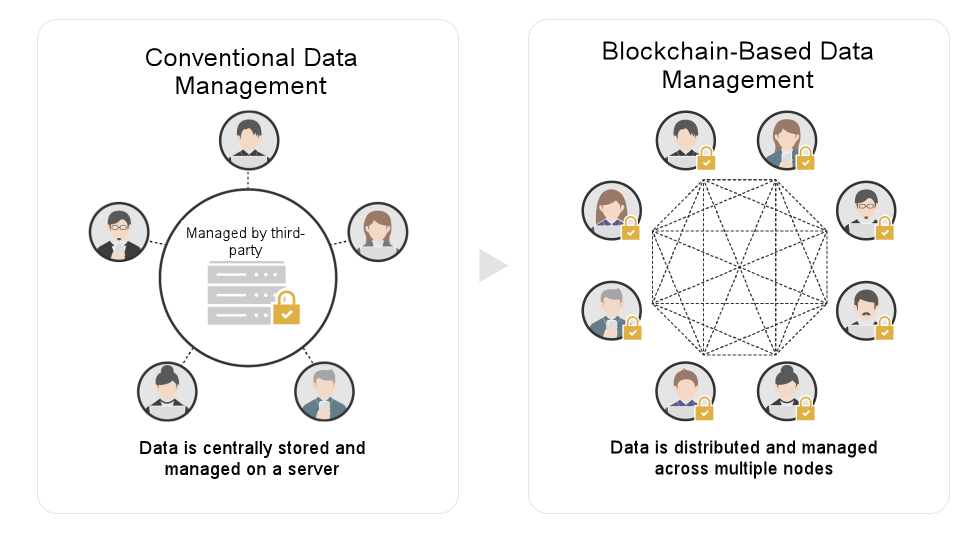
Blockchain is sometimes called the “internet of value.” Until now, the internet has mainly been used to exchange information. But information can be falsified and copied easily. When it comes to ownership rights with financial value, we can’t have falsified and copied versions in circulation.
Blockchain enables ownership and other rights to be exchanged securely. In the past, financial institutions played the role of guaranteeing that those rights are genuine. With blockchain, the legitimacy of a transaction can be ensured without relying on a centralized intermediary. It is opening the door to a world where a range of rights-based assets can be traded more smoothly on a network that anyone can access, although there are still some restrictions.
- 拡大
- Source: Nomura Securities website, “What Are Real Estate Security Tokens?”
(“Nodes” are referring to computers and mobile devices)
Q. So, what exactly is an ST? Bitcoin and other cryptocurrencies also use blockchain, don’t they? How are STs different?
An ST is a security whose ownership is recorded and managed using blockchain.
With cryptocurrencies, the person holding the token is the owner, and no third party is needed to prove that ownership. Transactions can be conducted anonymously. If it is stolen, ownership effectively changes hands. However, STs are designed as financial products under the regulations of Japan’s Financial Instruments and Exchange Act, and the issuer keeps track of who the actual owner is.
Sometimes people say cryptocurrencies are risky because they can easily be stolen. But STs work differently. Even if someone were to steal an ST, the thief’s name will be recorded in the ledger managed by the issuer. The inability to conduct anonymous transactions significantly reduces the incentive to steal.
- 拡大
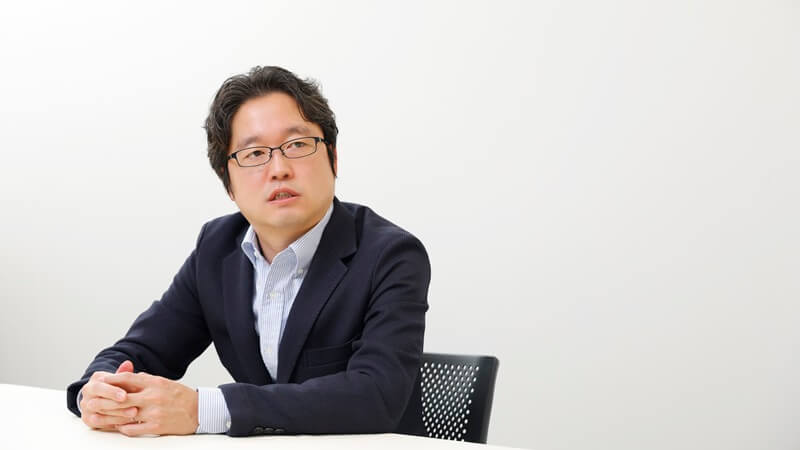
- Toshinori Sasaki, Head of Digital Asset Strategy Department, Nomura Holdings
Q. A common example of STs is real estate STs. What are they?
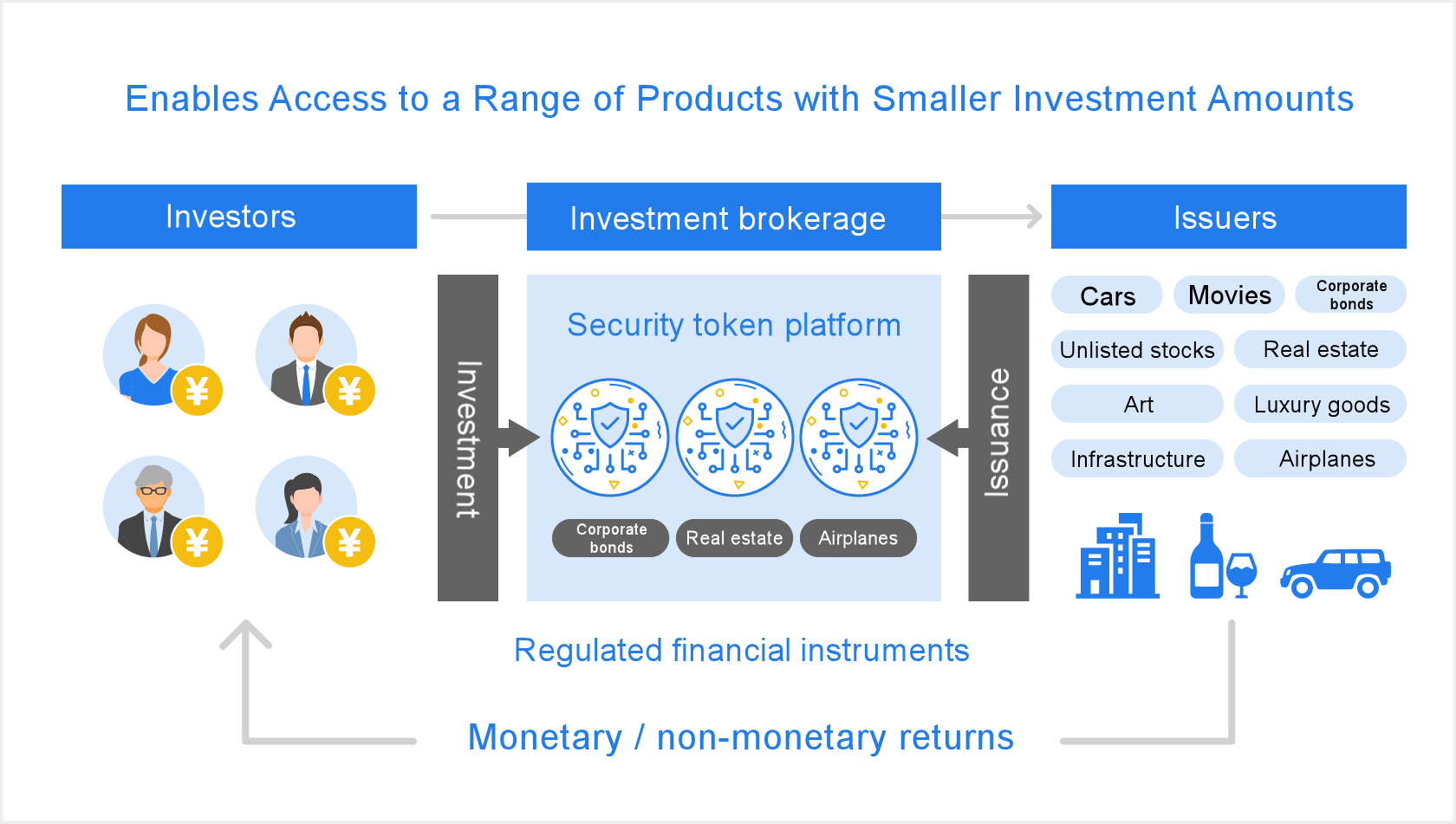
Real estate STs are a good example for understanding how STs work. With real estate STs, tokens are issued as securities backed by a specific property — for example, a high-rise condominium building in Tokyo. The tokens represent the rights attached to the securities. By purchasing these tokens, investors obtain the right to receive returns generated by that property.
Normally, if an individual wants to invest in real estate, they would need to borrow tens of millions of yen to purchase an apartment so that they could earn rental income as a return. With real estate STs, investors can buy an interest in a large property in fractional units, such as for JPY 100,000 or JPY 1,000,000, allowing them to receive returns. This is one of their key characteristics.
Q. Real Estate Investment Trusts (REITs) also allow people to invest with relatively small amounts. What’s the difference between REITs and real estate STs?
With REITs, investors usually invest in a single portfolio made up of several properties. That diversification has its advantages, but it also makes it harder to see exactly what you are investing in. With STs, a single property can be tokenized and offered as the investment target. People in the industry sometimes describe this as giving investors a more “tangible” sense of ownership. That feeling that you own a specific property is another defining feature of STs.
- 拡大
- Source: “What Are Security Tokens?”, Fin Wing (Nomura’s financial and economic education site)
There are also cases where holders of STs receive non-financial returns, sometimes called digital benefits. These can include opportunities to buy local specialties from the area where the property is located or perks at hotels and restaurants. Issuers are finding creative ways to build relationships with investors, and investors may develop an attachment to the property they own, similar to the attachment created by receiving shareholder benefits. The emergence of STs is encouraging a range of new ideas and initiatives.
In theory, these kinds of benefits were possible under the traditional securities framework, but it was not possible in practice because financial institutions’ operations and systems were not set up to support them. A major achievement of ST initiatives is that they have led financial institutions to adopt a common framework, making these kinds of benefits possible in practice.
Q. Aside from real estate, what other use cases are emerging for STs?
To give you one example, in December 2025, four Nomura Group companies (Nomura Holdings, Nomura Asset Management, Nomura Trust and Banking, and BOOSTRY) issued an ST that enables investment in a domestic venture capital fund. This issuance was the first of its kind in Japan, and it made use of J-Ships, a framework for securities offered to professional investors. J-Ships allows securities companies to sell shares in unlisted companies and investment trusts to professional investors known as “qualified investors.”
Until recently, individual qualified investors did not have many options if they wanted to invest in the growth of unlisted startups. STs, together with the expertise being developed alongside them, are now being applied to areas where investment had been difficult under conventional securities frameworks.
From an investor’s perspective, STs are expanding the range of investable assets and helping to create more resilient portfolios. But we are not only interested in creating new ST products. I also believe that there is value in tokenizing existing securities.
Q. What would that involve, specifically?
We could tokenize existing securities such as government bonds, listed stocks, and investment trusts. For example, today’s stock market only allows trading during exchange hours, and settlement also takes time. If tokenization continues to advance, it may become possible to trade 24 hours a day, 365 days a year, from anywhere in the world. The impact could be even greater if tokenizing extends to securities that already have large markets.
Tokenized securities could also serve as a bridge between cryptocurrencies and traditional financial markets. People holding cryptocurrencies, for example, may be able to use them to purchase investment trusts directly without first converting their assets into cash. That kind of future is starting to feel within our reach.
Q. How is Nomura involved in STs?
The ST framework relies on collaboration among multiple participants. At Nomura, Nomura Securities acts as the distributor and is responsible for explaining products to investors. As a securities company with an emphasis on face-to-face service, we carefully communicate the value and future prospects of the underlying property in cases such as real estate STs. Other group companies, such as Nomura Asset Management and Nomura Trust and Banking, are also involved in their respective areas of expertise.
At Nomura Holdings, the Digital Asset Strategy Department, which I lead, is responsible for groupwide digital asset strategy and business development. We work closely with each company and business division.
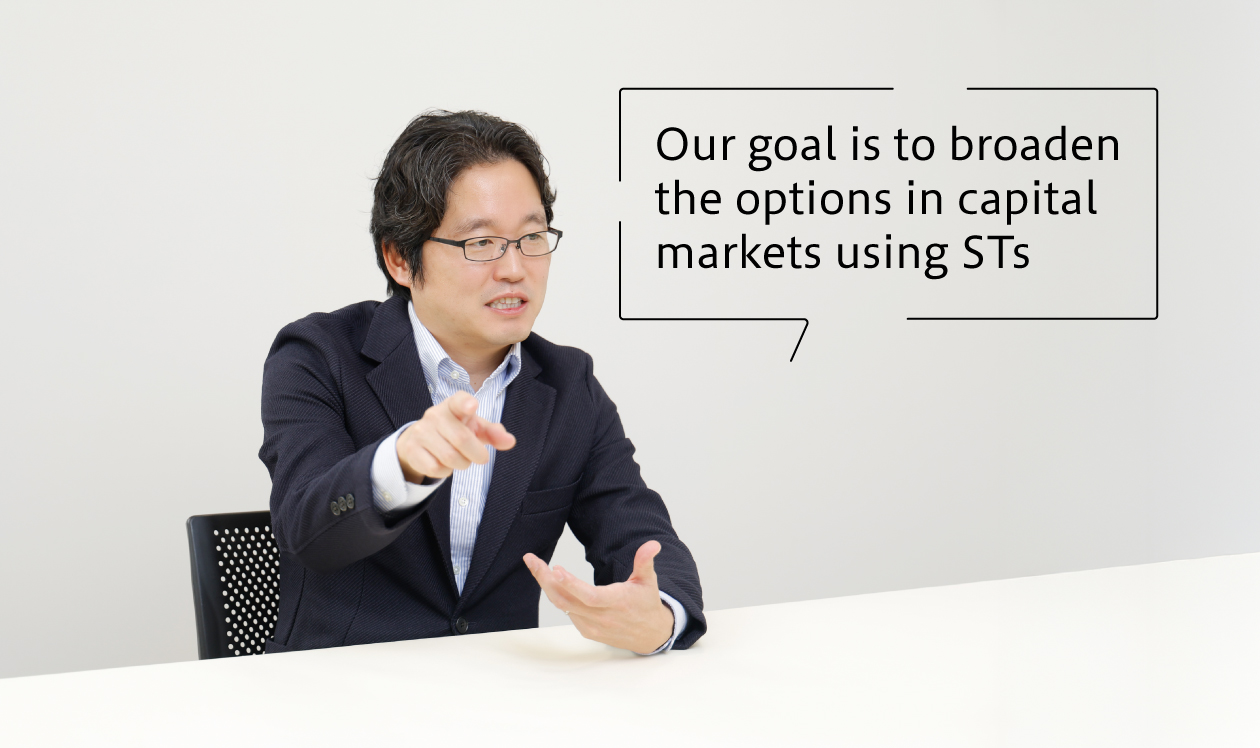
Our mission is to expand capital markets through digital assets. Our goal is not to replace traditional finance with STs, but to broaden the range of options available in capital markets. We want to open up new possibilities for fundraising and investing in ways that have never existed before.
Q. How might capital markets change as digital assets evolve?
The ideal future, in my view, is one where investors no longer need to think about the current institutional or systemic limitations.
Let’s say for example you want to buy a small position in Brazilian stocks today. It’s not easy. You need to figure out which brokerage can offer them, complete the required procedures, and deal with foreign exchange issues. And after you sell, it can take several days for the cash to arrive in your account.
As digital assets gain wider adoption, those barriers will gradually disappear. In the future, AI agents may understand your preferences and suggest the optimal portfolio from assets around the world. If you like it, you may be able to buy it instantly. I believe that kind of future could become a reality.
I want to help create a society where more people can access capital markets more easily.
※This article explains how security tokens work and provides examples. It is not intended to offer specific investment advice. If you are considering investing, please consult a professional adviser.
Profile
Toshinori Sasaki
Head of Digital Asset Strategy Department, Nomura Holdings
After graduating from the Graduate School of Systems and Information Engineering at the University of Tsukuba, Toshinori Sasaki worked at a software company developing systems for financial institutions. He joined Nomura Securities in 2008. In the Investment Banking Division, he gained practical experience in raising capital through a variety of financial products. Later, he worked in a new business development department at Nomura where he conducted research into fundraising using blockchain technology. In 2019, he founded BOOSTRY Co., Inc. to develop platforms for STs and other digital securities, and became its CEO. He has held his current position since March 2025.