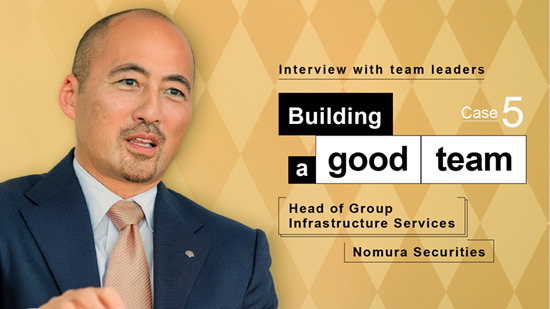


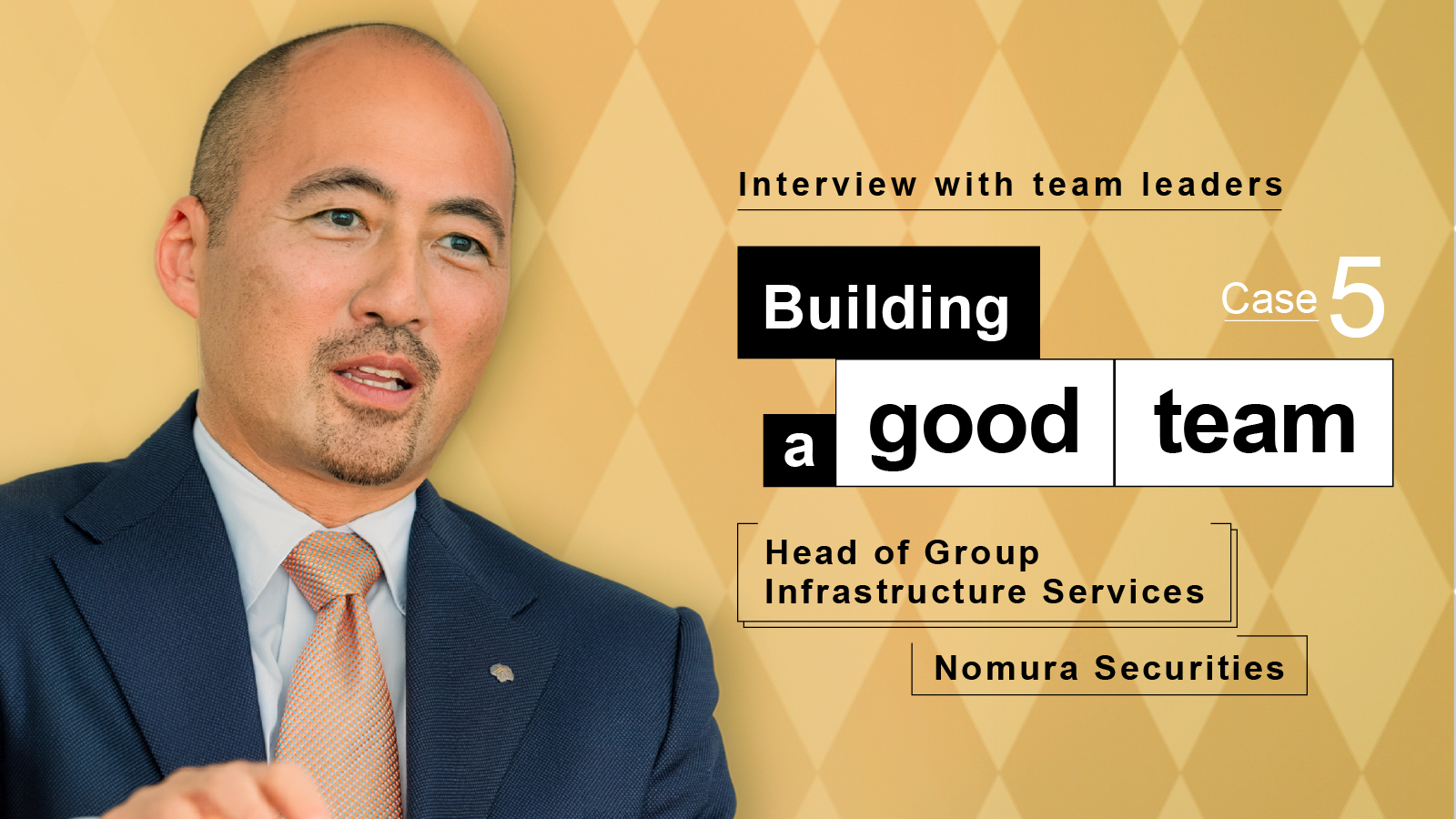
The fifth installment of our interview series with Nomura leaders features Ryu Kamekura, Head of Group Infrastructure Services at Nomura Securities.
Leading a team of 1,500 people responsible for standardizing IT infrastructure across Nomura Group, he shares how he brings out the best in his team members and aligns them around a common goal. He also discusses his approach to cross-cultural communication and how he ensures key messages are understood throughout the organization.
Having spent his childhood in Brazil and built extensive international business experience, he offers insights into leading a highly diverse team. Drawing on his practical experience, we explore two essentials for advancing global standardization: effective communication and a systemized approach to learning.
Q. First, could you briefly introduce your team and what it does?
We are an IT infrastructure team. In simple terms, we are responsible for the core IT systems that underpin the firm’s platform—infrastructure such as servers, PCs, telephones, internet connectivity, and online meetings. Our primary mission is to drive the global standardization of IT infrastructure across Nomura Group.
The team is made up of both development and operations functions and is organized by technical domain, such as telephony, PCs, servers, and networks. IT infrastructure is divided into nearly 100 specialized fields, each with its own specialists. Globally, we have a team of 1,500 people, including 300 colleagues based in Japan.
In Japan, more than 90% of our team members are mid-career professionals in their respective fields, and our members represent 18 nationalities.
Q. Why do you need so many people?
We manage the IT foundation that supports all of Nomura. Across the group, we have around 60,000 PCs, so to handle repairs and user support, we have about one IT staff member for every 100 employees. We also have about 100 network lines connected from our Tokyo data center to locations across Japan, with around 10 people dedicated to supporting these communications. On top of that, we operate 40,000 servers worldwide, and each region has the staff needed to support a global business that runs 24 hours a day, 365 days a year.
Nomura’s efforts to standardize IT infrastructure globally began after we acquired Lehman Brothers’ business operations. At first, the focus was only on the Wholesale Division, which operated globally, but over time the scope expanded, along with the number of people involved.
None of these functions operate on their own. Even simple tasks—like checking email, joining an online meeting, or accessing an internal system— depend on multiple technologies working together, including endpoints, authentication, networks, servers, security, communication lines, and cloud services. If any of these fails, business operations can be affected. People may not notice it day to day, but keeping everything running smoothly takes a great deal of specialized expertise.
Q. Is an IT team of this size common in the industry?
In Japan, it is common to outsource IT operations to external vendors, so it can be difficult to tell how many people are actually involved internally. However, global securities firms usually manage IT in-house, so I think many of them have teams about the same size as ours. In the securities industry, IT systems are used on a very large scale and across many areas of the business. If too much is outsourced, it becomes harder to keep up with the latest technology trends.
Technology changes rapidly, and business needs are constantly evolving as well. That is why it is important to have a structure where people close to the frontlines can assess technology and make decisions quickly.
- 拡大
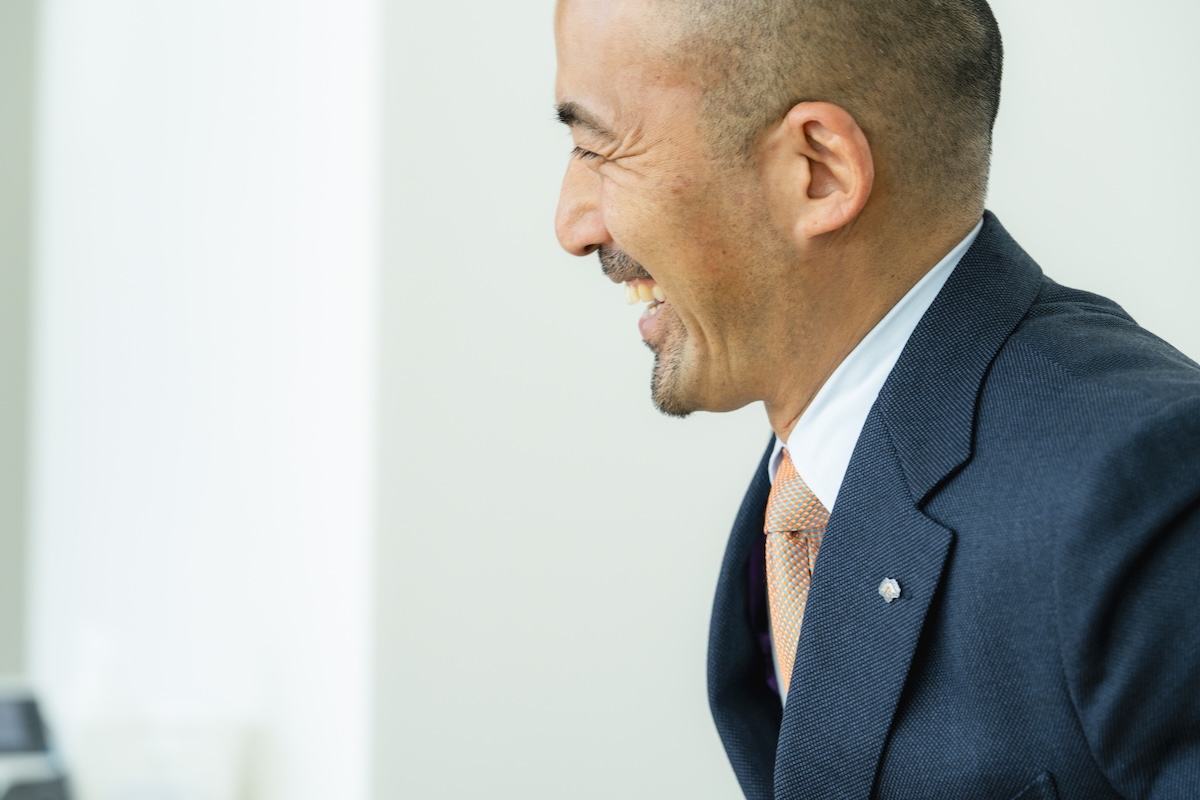
- Ryu Kamekura, Head of Group Infrastructure Services at Nomura Securities
Q. What is your team mindful of in its day-to-day work?
There are two main things. First, we try not to hold on to old systems for too long and replace them early. Otherwise, we cannot bring in new technology. People usually replace their smartphones every three years or so, and we take a similar approach in IT. Second, we make sure to keep up with new technologies. It is like quickly learning how to use a new feature on your smartphone.
That said, in reality, we often have to introduce new technologies while old systems are still in place. We need to balance the new with the existing environment and keep everything running smoothly. That takes a lot of skill and care.
To support this, for the past five years or so, we have asked all team members to spend 10 hours of their working time each month on training, gathering new information, and building new skills. Fortunately, because Nomura operates globally, one of our strengths is that we can share overseas trends quickly. We also give people opportunities to work with colleagues in other regions during overseas business trips, and we share technology through workshops.
In addition, we hold optional sessions for people in IT-related departments. For example, if we announce that someone will give an online talk on a certain technology, people join because they are interested, even if attendance is not required. Since talent tends to move more freely overseas, we also benefit from people with cutting-edge experience joining Nomura from other companies and bringing that knowledge with them.
The world of IT infrastructure is constantly changing—from the spread of the internet to cloud adoption, hybrid work, and now AI. Because change happens so fast, if you do not make time to learn, you can quickly fall behind. I see those 10 hours each month as the minimum needed to stay current.
Q. Was former Lehman Brothers’ know-how helpful in building global standardization?
Absolutely. They were already operating as a fully integrated global platform, while Nomura’s IT operations were still split by region. During the standardization process, there were a lot of cultural differences between Japan and overseas. People would say things like, “Why do we have to change?” “Why do we have to do this in English?” and “This is Japan!”
But each time we made a change, they gradually began to see the benefits. Once everything finally came together, globally integrated operations also became the norm at Nomura. The pandemic was another major turning point that helped push this forward.
Q. What do you think makes a strong team?
For me, a strong team is one with diversity, including cultural diversity. It is also a team where people are not dependent on just one technology, but can expand their skills and do a variety of things. If a team relies too much on one technology, it becomes vulnerable when that technology becomes outdated.
People in different countries also bring different perspectives. For example, Japan is often seen as more relationship driven, while Europe and the U.S. tend to be more logic driven. When different ways of thinking come together, you get a wider range of ideas and viewpoints. I do not think we need to force everyone into uniformity. It is fine for those differences to remain.
In the past, we separated reporting lines by nationality and language, and assigned managers accordingly. But now people can work together without worrying too much about those differences.
Q. How long did it take for those barriers to go away?
It took five years. It was not easy. But whenever we did not agree on something, we tried to understand the reasons behind it right away. Because people were not fully confident in their non-native language, we made a point of not relying on email and instead talking face-to-face. We were very intentional about that. Meeting in person makes a big difference, so we also had people travel from overseas to Japan.
We kept at it for five years with the message “Let’s talk about anything.” Once you can see the other person’s face, you realize there is no hostility—they were simply doing their best, even if their words were not perfect. Working side by side during the day also helps people open up and connect more personally afterwards, which helps to build stronger relationships. So, when colleagues come to Japan on business trips, we try to create opportunities for them to deepen those connections not only at work, but outside work as well.

Q. What kind of team are you aiming for?
We are working to build a “Global One Team” and “Global One Infrastructure.” “Global One Team” means a team that can work across countries and locations toward the same goals and in the same way. “Global One Infrastructure” means standardizing our IT infrastructure across locations and operating as an integrated platform.
To make that possible, over the past two to three years we have been bringing in engineers from other regions to work with us in Japan. Sometimes they stay for a month. Ideally, I would like to send everyone abroad on business trips so they can gain a wide range of first-hand experience. There is a big difference between hearing about something and seeing it for yourself.
Q. How do you keep a large team moving toward the same goal?
I try to communicate clear messages and goals in a simple and consistent way. I also make sure it is never one-way communication— I always leave room for Q&A. That is why every time I visit one of our offices around the world, I hold a town hall meeting and set aside time for people to ask questions.
I don’t want to miss the chance to communicate just because we speak different languages or come from different countries. Once you start talking, you often find that people have great ideas that everyone can learn from. Those kinds of conversations happen all the time. Our overseas teams are quick to adopt cutting-edge technologies, so talking with them is always fascinating.
Q. By overseas, do you mean the United States?
The United States, as well as Nomura’s other major hubs—the UK, Hong Kong, Singapore, and India—move very quickly. People are constantly on the move, often changing companies faster than they move internally within the same company. Someone who worked on a cutting-edge technology at one company can bring that expertise to the next, so knowledge spreads quickly. Of course, people may leave again just as quickly. But we accept that reality and see it as part of a cycle that help both the team and the company continue to improve.
Q. What makes IT infrastructure work especially interesting?
Every department uses IT, so it is important to understand the needs of the entire company and think about which technologies are most appropriate. IT infrastructure is not just a technical job. It is a role that helps you see what is happening across the company and how the business is changing. Being able to see what is happening in each department and what will be needed next is one of the most interesting parts of this work. I think what makes IT infrastructure so profound is that you’re able to think not only about technology, but also about the business as a whole.

Ryu Kamekura
Head of Group Infrastructure Services, Nomura Securities
Ryu joined Nomura Research Institute in 1994 and moved to Nomura Securities in 2010, where he was assigned to the then Global IT Department. For more than 15 years, he has been involved in the development and operation of IT infrastructure for Nomura Securities and the broader Nomura Group. He assumed his current role in 2020.
Ryu spent part of his childhood in Brazil, and has built extensive international experience through assignments in San Francisco during his time at Nomura Research Institute and in London while at Nomura Securities. He holds a master’s degree in computer science from Keio University.